

Knowledge Base
Magnesium
You are reading:
Contents
On this page
Magnesium is involved in more bodily functions than any other mineral — more than 300 enzymatic processes depend on it. Yet intake through a typical Western diet is structurally on the low side.
Want to know immediately which form suits you? Go to the Magnesium — Choice Guide. Prefer to understand the differences first? Read on.
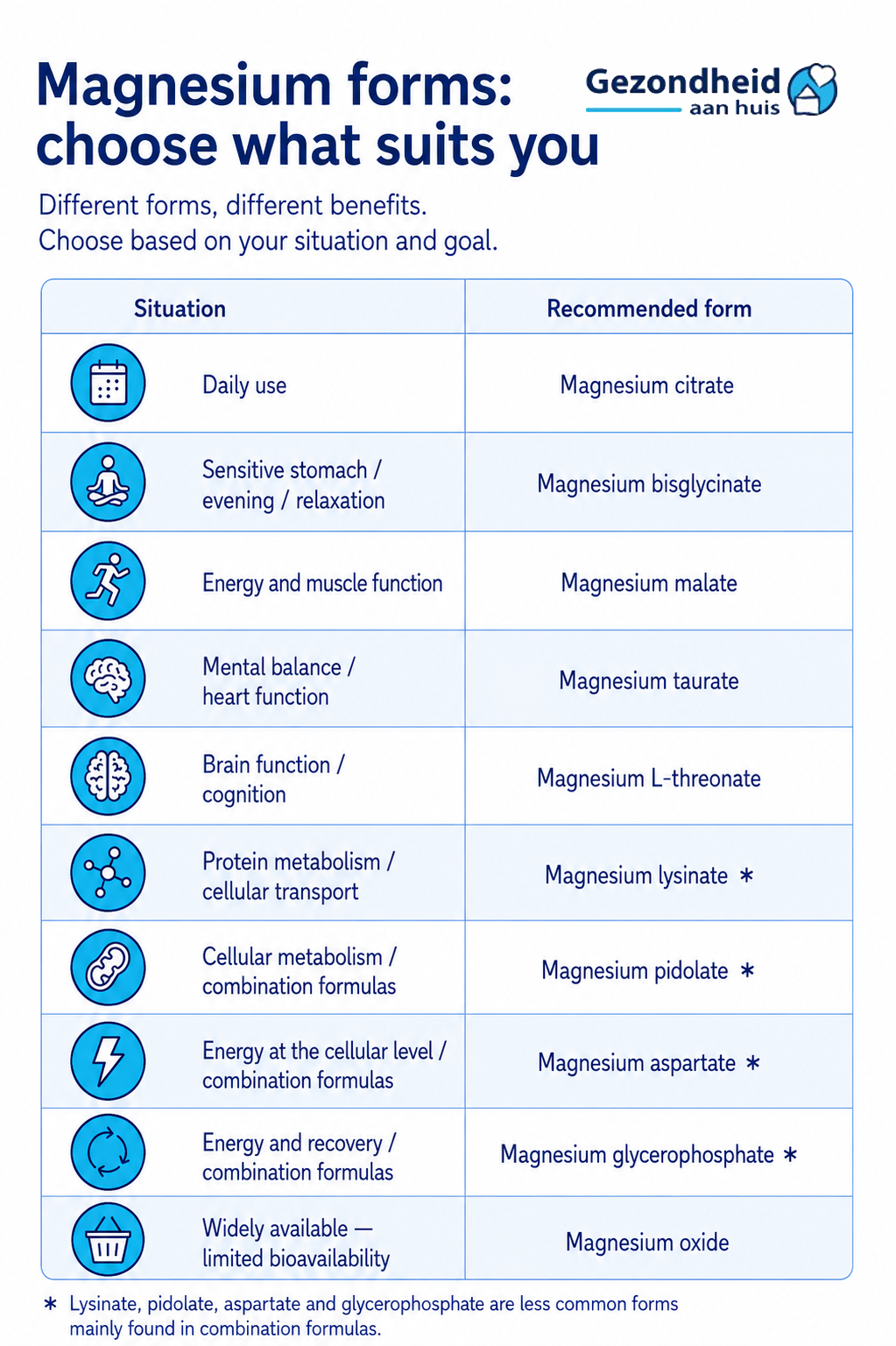
For a detailed comparison of the different forms, read “Magnesium forms compared”
Magnesium in food and supplementation
Magnesium occurs naturally in a wide range of foods. Whole grains, nuts, seeds, legumes, leafy greens and pure cacao are among the richest sources. A varied diet provides enough magnesium for most people, but actual absorption varies widely and depends on soil quality, preparation methods and the presence of anti‑nutrients such as phytic acid.
Athletes and people with an active lifestyle lose additional magnesium through sweat. During intensive training, the requirement can exceed what is achievable through diet alone. This makes magnesium one of the most relevant minerals for those who train regularly.
The adult human body contains around 25 grams of magnesium (25,000 mg). Roughly 60% is stored in bone tissue; the rest is found in muscle and soft tissues. Only about 1% circulates freely in the blood — meaning blood levels are not a reliable indicator of total magnesium status.
More on this in Magnesium in food
We are often asked: “Which magnesium should I take?” The answer depends on what you’re looking for. The overview below helps you get started.
A full comparison of all forms, including a decision guide, can be found in Magnesium forms compared.
Chemical forms in supplements
Magnesium supplements use different chemical compounds. These compounds vary in solubility, absorption and how the body processes them.
Magnesium citrate
Magnesium bound to citric acid. Well‑soluble, versatile and one of the most commonly used forms. Suitable as a daily base.
Magnesium bisglycinate
Magnesium bound to two glycine molecules. Glycine is an amino acid associated with calming applications. Bisglycinate is well tolerated, even with a sensitive stomach, and often appears in evening and relaxation formulas.
Magnesium malate
Magnesium bound to malic acid. Malic acid plays a role in energy metabolism (citric acid cycle). Malate appears in formulas aimed at energy and muscle function.
Magnesium taurate
Magnesium bound to taurine. Taurine acts as an inhibitory neurotransmitter. Taurate is used in formulas targeting mental balance and heart function.
Magnesium L‑threonate
A relatively new form in which magnesium is bound to L‑threonate. Studied specifically for its ability to cross the blood‑brain barrier. Often used in formulas focused on cognitive function.
Magnesium lysinate
Magnesium bound to lysine, an essential amino acid involved in protein metabolism and magnesium transport into the cell. Less common in the Dutch supplement market than citrate or bisglycinate.
Magnesium pidolate
Magnesium bound to pidolic acid, a metabolite involved in the glutamate cycle. Sometimes seen as a successor to magnesium orotate — see below.
Magnesium glycerophosphate
Magnesium bound to glycerophosphate, a compound involved in energy metabolism. Used in combination formulas.
Magnesium aspartate
Magnesium bound to aspartic acid, an amino acid involved in the citric acid cycle. One of the older organically bound forms, sometimes combined with other forms in multi‑magnesium formulas.
Magnesium oxide
The most common and least expensive form. Low elemental magnesium per gram and limited solubility. Widely available, but less suitable as the primary form in a high‑quality supplement.
Magnesium hydroxide
Magnesium bound to hydroxide ions. Registered as a medicinal product in the Netherlands, not as a supplement. Used as an antacid and laxative.
Magnesium orotate — not permitted as a food supplement in the EU
Magnesium orotate was a popular form bound to orotic acid. In the EU, magnesium orotate is not permitted as a food supplement. Those looking for magnesium orotate will find magnesium pidolate as an available alternative.
Organic or inorganic binding
The terms “organic” and “inorganic” refer only to the chemical bond — not to product quality.
- Organically bound magnesium is linked to a carbon‑containing compound such as an amino acid or organic acid.
- Inorganically bound magnesium is linked to a non‑carbon compound such as oxide or chloride.
Organically bound forms are generally more soluble.
EFSA claims
The European Food Safety Authority (EFSA) has authorised the following health claims for magnesium:
Magnesium contributes to:
- reduction of tiredness and fatigue
- normal energy‑yielding metabolism
- normal muscle function
- normal functioning of the nervous system
- normal psychological function
- normal protein synthesis
- electrolyte balance
- maintenance of normal bones
- the process of cell division
Understanding the label
Supplement labels typically list both the total amount of the compound and the amount of elemental magnesium — the actual mineral the body absorbs. A capsule containing 500 mg magnesium citrate provides roughly 80 mg elemental magnesium.
Always compare supplements based on elemental magnesium per daily serving, not on total compound weight.
Quality considerations
When assessing a magnesium supplement, pay attention to four points:
- Elemental magnesium — compare per daily serving, not per compound weight.
- Form — look for the full chemical name: magnesium citrate, magnesium bisglycinate, magnesium malate. “Magnesium” without specification is often magnesium oxide.
- Daily dosage — check how many capsules or tablets make up the daily dose.
- Excipients — for sensitive stomachs or clean‑label preferences: check fillers, colourants and anti‑caking agents.
More on reading labels: How to read a supplement label
Key quality parameters for magnesium supplements include the raw material form, elemental magnesium per daily dose, absence of unnecessary excipients and label transparency. A cheaper supplement containing magnesium oxide provides far less usable magnesium per capsule than a more expensive bisglycinate or citrate product — even if the number on the label looks similar.
Magnesium is a mineral, not a plant ingredient, so organic certification does not apply in the same way as for herbal products. Quality is determined by raw material form, purity and production conditions.
More on this in How to recognise a quality supplement and Clean label in supplements
Combinations
Magnesium is often combined with other nutrients. Common combinations include magnesium with vitamin B6 (both involved in normal nervous system function) and magnesium with vitamin D (magnesium acts as a cofactor in vitamin D activation in the liver and kidneys).
Magnesium and calcium share part of the same absorption pathways in the gut. For optimal absorption, take them at different times. More in the FAQ below.
In evening and relaxation formulas, magnesium bisglycinate often appears alongside botanicals such as valerian and lemon balm. In energy formulas, magnesium malate is frequently combined with B vitamins.
More on combinations: Combining supplements: what works together and what doesn’t?
Safety
When to be cautious If you use medication, are pregnant, breastfeeding or have a medical condition, consult your doctor or pharmacist first.
Upper limit EFSA has set a safe upper limit of 250 mg elemental magnesium per day from supplements for adults. Higher doses may cause diarrhoea or stomach discomfort. Excess from food is excreted by the kidneys.
Medication interactions Certain antibiotics (tetracyclines, fluoroquinolones) and thyroid medication (levothyroxine) can have reduced absorption when taken with magnesium. Take magnesium at least 2 hours apart. More in Supplements and medication.
Proton pump inhibitors (PPIs) Long‑term PPI use is associated with lower magnesium levels. Extra attention to magnesium intake is important.
Beta‑blockers Use of beta‑blockers is associated with increased magnesium utilisation. Extra attention to intake may be relevant. Consult your doctor if unsure.
Frequently asked questions
Is magnesium the same in every form?
The mineral is the same, but the compound differs. The compound determines solubility, tolerance and application. A full comparison is available in Magnesium forms compared.
How much magnesium do I need?
The Nutrient Reference Value (NRV) for magnesium is 375 mg per day for adults. The Health Council of the Netherlands (Gezondheidsraad) provides age‑ and sex‑specific recommendations. Follow the product guidance.
Can I take too much magnesium?
Overdose risk from food is low. Excess is excreted by the kidneys. Very high supplemental doses (>250 mg elemental magnesium/day) may cause diarrhoea or stomach discomfort.
When should I take magnesium?
Depends on the form and purpose. Bisglycinate and taurate are often taken in the evening. Malate and citrate can be taken during the day. Taking magnesium with a meal reduces stomach discomfort.
What is the difference between elemental magnesium and compound weight?
Elemental magnesium is the actual mineral. Compound weight includes the molecule it is bound to. Always compare based on elemental magnesium.
What is the relationship between magnesium and vitamin D?
Magnesium is an essential cofactor for enzymes that activate vitamin D. Without sufficient magnesium, vitamin D conversion is less efficient.
Is magnesium ascorbate a form of magnesium?
Yes — magnesium bound to ascorbic acid (vitamin C). It provides both nutrients. Elemental magnesium per gram is relatively low. Check the label.
Why are few magnesium supplements organic‑certified?
Magnesium is a mineral, not an agricultural product. Organic certification does not apply. Quality depends on raw material form, purity and production conditions.
What is magnesium orotate?
Magnesium orotate was a popular form bound to orotic acid. In the EU, magnesium orotate is not permitted as a food supplement. Magnesium pidolate is an available alternative.
Can I take magnesium with calcium?
They partially compete for absorption. For optimal uptake, take them at different times.
Does magnesium influence other nutrients?
Yes — magnesium is a cofactor in vitamin D activation and influences calcium regulation. It also works alongside vitamin B6 in normal nervous system function.
Need help choosing?
Want to compare magnesium products by form, elemental content, excipients and price? Read the Magnesium Choice Guide or contact our qualified supplement advisors: Phone 0318 – 64 89 89, WhatsApp 0683702040, or email info@gezondheidaanhuis.nl.
About this article

Available in