

Knowledge Base
Clean label supplements: what does it mean?
You are reading:
Contents
On this page
The term “clean label” appears increasingly on supplement packaging and in marketing. Yet what it actually means is less clear. There is no official definition, no legal standard and no independent body that monitors its use. As a result, clean label can be meaningful, but it can also be used loosely. This article explains what the term means in practice and how you can assess whether a product that claims to be “clean label” truly meets that expectation.
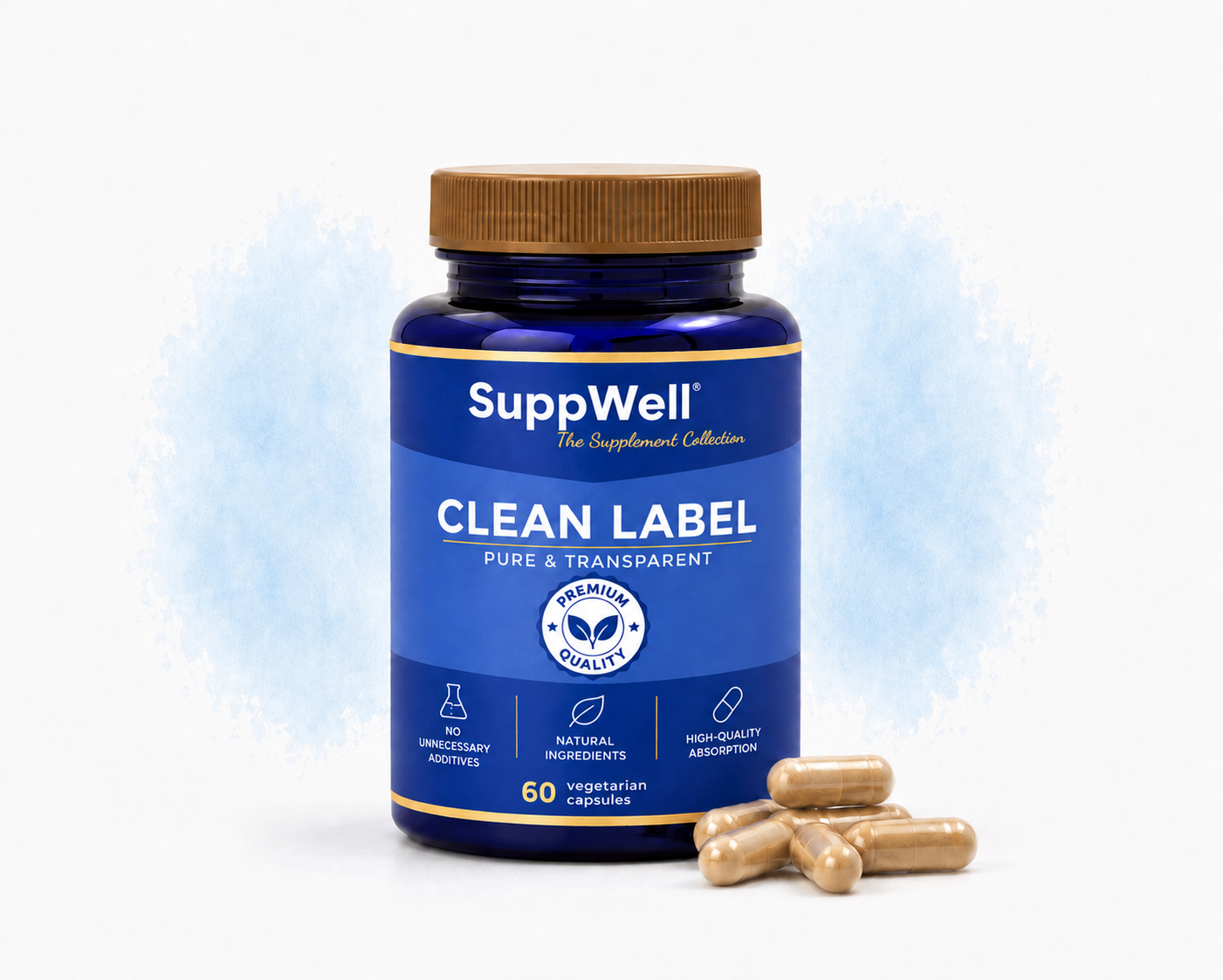
What does clean label mean in practice?
Clean label is a market term rather than a legal category. In the food industry, it is used for products with short, recognisable ingredient lists that avoid synthetic additives, colourings, flavourings or unnecessary fillers. In supplements, the meaning is similar, but with a few specific considerations.
In practice, clean label in supplements generally refers to products that avoid synthetic colourings and flavourings, minimise fillers and binders, use plant‑based capsule shells instead of gelatine, exclude common allergens such as gluten, soy or lactose, and list all ingredients transparently, including excipients. Some manufacturers also emphasise natural or organic raw materials as part of their clean label approach.
None of these characteristics is legally required or standardised. A manufacturer can use the term “clean label” without meeting any particular threshold. This makes reading the ingredient list critically important.
When is it mostly a marketing term?
Clean label loses its meaning when the ingredient list does not support the claim. This happens when excipients are not named or are grouped under vague headings, when raw material forms are not fully spelled out, when a product highlights the absence of one specific substance while still relying on other common additives, or when no certifications, analysis reports or independent confirmations are available.
When is it more than marketing?
A clean label claim becomes credible when the product’s composition reflects it. The ingredient list is the most reliable source of truth. A genuinely clean label supplement has a short, purposeful ingredient list, especially in single‑nutrient products. Every excipient serves a functional role rather than being included solely for production convenience. The capsule shell is plant‑based and clearly stated as such. Hidden allergens are absent. Active substances are fully named, including their chemical form, so the user knows exactly what is being taken.
Clean label isn’t the same as high quality
A clean label supplement is not automatically a high‑quality supplement. The absence of additives says something about the formulation, but nothing about the raw material form, bioavailability or concentration of the active substance. A product can have a minimal ingredient list and still rely on inexpensive inorganic mineral forms. Conversely, a supplement with more excipients can still use excellent raw materials.
Clean label and quality can overlap, but they are not interchangeable. Anyone evaluating a supplement should consider both the ingredient list and the quality of the raw materials used. For more detail, see How to Read a Supplement Label and How to Recognise a High‑Quality Supplement.
How to judge a clean label claim
The most reliable way to assess a clean label claim is to read the ingredient list rather than the front of the pack. Look at the number of excipients and whether each has a clear purpose. Check whether the capsule shell is plant‑based and explicitly stated. Confirm that raw material forms are fully spelled out. And always evaluate clean label alongside raw material quality, because they represent two separate criteria.
Clean label is a meaningful direction, but only when the ingredient list supports it.
If you’d like to know which products in the range of Gezondheid aan huis follow a clean label formulation, our pharmacy assistants and orthomolecular therapists are happy to help.
About this article
Available in