

Knowledge Base
Magnesium in food
You are reading:
Contents
On this page
Magnesium occurs naturally in many foods. Nevertheless, it is one of the minerals for which average intake in the Western diet falls below the reference values. One possible reason is that modern agricultural practices affect magnesium levels in the soil and, consequently, in crops.
For more information about the functions and uses of magnesium, visit our main Magnesium page.
How much magnesium do you need per day?
The European Food Safety Authority (EFSA) uses a Reference Intake (RI) of 375 mg of magnesium per day for adults. This is the value shown on supplement labels as the basis for calculating the RI percentage. It is a standardised European value used for labelling purposes and does not necessarily represent an individual recommendation.
The Health Council of the Netherlands establishes recommendations for specific population groups based on scientific evidence. These recommendations are lower than the EFSA value: 350 mg per day for men and 300 mg per day for women.
According to the Health Council, there is currently insufficient information to establish an increased magnesium requirement during pregnancy. The recommendation for pregnant women therefore remains the same as for adult women: 300 mg per day.
Use the Health Council’s recommendation as a guideline for your daily intake.
Foods rich in magnesium
Magnesium is found primarily in plant-based foods. Green leafy vegetables contain magnesium as part of the chlorophyll molecule, the pigment that gives plants their green colour. Nuts, seeds and legumes are other magnesium-rich sources.
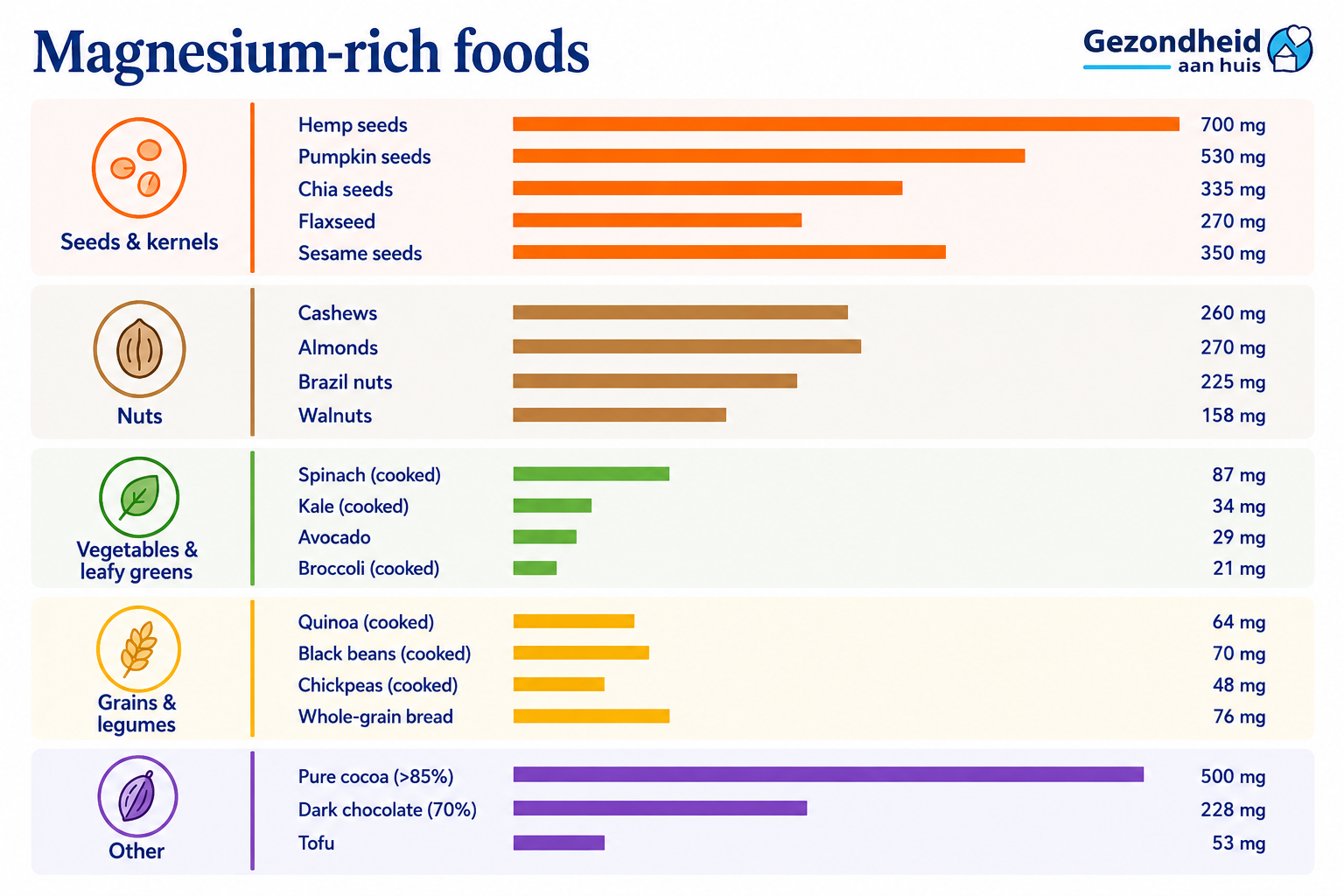
Magnesium content per 100 grams. Values are approximate and based on average levels. Actual levels vary depending on origin, cultivation method and preparation method.
What influences the absorption of magnesium from food?
The amount of magnesium in a food is not the same as the amount absorbed by the body. Several factors influence its absorption. Some reduce absorption, while others enhance it.
Phytic acid
Grains, legumes and nuts contain phytic acid, which can bind minerals such as magnesium and reduce their absorption. Soaking, sprouting or fermenting these foods significantly reduces their phytic acid content.
A practical example is soaking oats overnight, possibly with a small amount of yoghurt or buttermilk. This lowers the phytic acid concentration and improves mineral absorption the following morning.
Preparation method
Boiling vegetables causes magnesium to leach into the cooking water. Steaming or stir-frying preserves more of the mineral content. If you want to pay particular attention to your magnesium intake, choose preparation methods that do not require the cooking water to be discarded.
Soil quality and modern agriculture
The magnesium concentration in plants depends on the magnesium content of the soil. Intensive agriculture, soil depletion and the use of certain artificial fertilisers have affected magnesium levels in crops over recent decades. Organically grown foods are often cultivated in richer soils, although this varies considerably depending on the region and cultivation method.
Vitamin D: supporting magnesium absorption
Vitamin D plays an active role in regulating magnesium absorption in the small intestine. It promotes the production of transport proteins that help magnesium pass through the intestinal wall.
A vitamin D deficiency may therefore indirectly affect magnesium absorption. This makes vitamin D and magnesium a logical synergistic combination and explains why they are often used together in combination supplements.
Alcohol and certain medications
Chronic alcohol consumption affects magnesium balance in several ways. It increases magnesium excretion through the kidneys, disrupts absorption in the intestines and inhibits the mobilisation of magnesium from bone tissue. This is not an effect caused by a single glass of wine, but by consistently high consumption of alcoholic beverages.
Certain medications can also affect magnesium balance. Long-term use of proton pump inhibitors, also known as acid-reducing medication, can reduce magnesium absorption in the intestines. Diuretics increase magnesium excretion through the kidneys.
If you use these medications for an extended period, it is advisable to consult a doctor or qualified druggist about your magnesium status.
Diet and supplementation: making an informed choice
Food is the primary source of magnesium. A varied diet containing sufficient nuts, seeds, whole grains and vegetables makes an important contribution to magnesium intake. Whether this provides enough magnesium depends on individual factors, including dietary habits, preparation methods, medication use, alcohol consumption and the quality of the crops.
If you are considering taking additional magnesium through a supplement, do not only look at the amount stated on the label. The chemical form is also important. Not all forms of magnesium are the same in terms of their composition and absorption pathway.
Two forms that deserve separate attention are magnesium sulphate and magnesium hydroxide. Magnesium sulphate is commonly known as Epsom salt and is also used in bath salts. Magnesium is absorbed through the skin to a limited extent. See also the question about magnesium oil below. When taken orally at higher doses, magnesium sulphate has a strong laxative effect. Magnesium hydroxide is registered as a medicinal product in the Netherlands.
For a detailed overview of all the forms of magnesium in our product range, read the article Forms of magnesium compared.
Would you like to know which magnesium products in our range are most suitable for your situation? Our qualified druggists and orthomolecular therapists will be happy to assist you.
Sources
- EFSA — Reference Intake (RI) for magnesium for adults: 375 mg/day. European Food Safety Authority. Dietary Reference Values for Nutrients.
- Health Council of the Netherlands — Magnesium recommendations by population group. Health Council of the Netherlands (2018). Dietary Reference Values for Vitamins and Minerals for Adults.
- RIVM — Comparison of EFSA and Dutch dietary reference values. RIVM (2024). Addition of Micronutrients to Foods and Supplements.
- Netherlands Nutrition Centre — Magnesium levels in foods.
- NCBI/PubMed — Magnesium in food and soil quality. Rosanoff A. et al. (2021). An Update on Magnesium and Bone Health.
- EFSA — Tolerable upper intake level for magnesium from supplements: 250 mg/day. EFSA Journal (2006). Tolerable Upper Intake Levels for Vitamins and Minerals.
About this article

Available in