

Knowledge Base
Magnesium — Choice Guide
You are reading:
Contents
On this page
What should you know before choosing a magnesium supplement? This guide will help you make a decision based solely on composition, quality and the information on the label.
Always compare magnesium supplements based on the amount of elemental magnesium per daily dose, not the capsule weight stated on the label or packaging. Choose the magnesium form that suits your situation, check the excipients and calculate the price per gram of elemental magnesium for a fair comparison.
Step 1 — Choose the right form for your needs
The magnesium form determines how it is absorbed and its typical use. Do not select a product based on price alone. The cheapest form, magnesium oxide, follows a different absorption pathway than organically bound forms.
Quick overview
- For daytime and general use: magnesium citrate or magnesium malate
- For evening use or a sensitive stomach: magnesium bisglycinate
- For daytime and evening use in one product: a multi-magnesium formula combining several forms
- For a focus on brain processes: magnesium L-threonate. This form has been specifically studied for its ability to cross the blood-brain barrier, but it is also more expensive
- For daily use on a budget: magnesium citrate
Capsule size and ease of use
The form of magnesium also affects capsule size. Magnesium bisglycinate is a bulky compound, which means its capsules are generally larger than those containing other forms.
Magnesium oxide is compact, allowing a relatively high amount of elemental magnesium to fit into a small capsule.
If you have difficulty swallowing large capsules, a powdered product or a combination product in smaller capsules may be a suitable alternative.
Step 2 — Read the label correctly
Elemental magnesium is the figure that matters, not the total weight of the magnesium compound.
A product containing “500 mg magnesium citrate” provides approximately 80 mg of elemental magnesium. A product stating “300 mg magnesium” may already be listing the elemental magnesium content directly.
Always compare products based on the amount of elemental magnesium per daily dose, not the capsule weight or the total amount of the compound.
What to look for on the label
- Elemental magnesium per daily dose, stated in milligrams
- The magnesium form used, such as bisglycinate, citrate or malate
- The number of capsules in the daily dose
- The percentage of the reference intake per daily dose
Example of a clearly presented label:
Magnesium bisglycinate 500 mg, providing 70 mg elemental magnesium (19% RI) Daily dose: 3 capsules providing 210 mg elemental magnesium (56% RI)
Remember to include magnesium from your multivitamin
Multivitamins often provide between 50 and 100 mg of magnesium per daily dose, usually in the form of magnesium oxide.
Include this amount when calculating your total daily intake if you also use a separate magnesium supplement. The safe upper intake level for magnesium from supplements is 250 mg of elemental magnesium per day for adults. Combining a multivitamin with a separate magnesium supplement may bring you close to this limit.
Step 3 — Assess the excipients
Excipients serve functional purposes. They help fill capsules, improve the flow of powders and maintain product stability. However, some excipients may be unnecessary or undesirable for sensitive users.
Common neutral excipients
- Rice flour and rice bran — commonly used neutral fillers
- Silica or silicon dioxide — a commonly used anti-caking agent
- Magnesium stearate — a lubricant widely used during capsule production
- HPMC or hydroxypropyl methylcellulose — a plant-based capsule shell
What to avoid if you have specific preferences
- Gelatin capsules — unsuitable for vegetarians and vegans
- Synthetic colors from the E100 series — not functionally necessary
- High sugar content — particularly in chewable tablets and gummies
- Flavorings or sweeteners — preferably absent from a pure supplement
A product without unnecessary additives is sometimes described as having a “clean label.” This term is not an official standard or certification. Any brand may use it without having to meet specific requirements.
Not every product presented as clean is genuinely free from unnecessary ingredients. The term is increasingly used as a marketing concept without a single, clearly defined standard.
Always read the ingredient list yourself. Find out more on the page “Clean label supplements: what does it mean?”
Step 4 — Understand the price difference
Magnesium supplements vary significantly in price, from just a few euros to more than €30 for 60 capsules. This difference is not arbitrary.
Factors that affect the price
- Raw material costs — magnesium bisglycinate and magnesium malate are more expensive to produce than magnesium oxide. Chelated forms require additional production steps. A very inexpensive product will almost always contain magnesium oxide or another simple inorganic form.
- Amount per capsule — a product containing 100 mg of elemental magnesium per capsule costs more per capsule than one containing 50 mg. However, fewer capsules are required to obtain the same daily dose. Always compare the price per gram of elemental magnesium, not the price per capsule or container.
- Certifications — GMP-certified production, independent quality testing and allergen-free manufacturing increase production costs.
- Excipients and capsule quality — plant-based HPMC capsules are more expensive than gelatin capsules.
Practical comparison
Calculate the price per gram of elemental magnesium: price of the container ÷ total amount of elemental magnesium in the container, expressed in grams. This allows you to compare products fairly, regardless of capsule size or magnesium compound.
Step 5 — Recognize red flags
- A high price for a product containing only magnesium oxide — there is no reason to pay a premium price for magnesium oxide
- No magnesium form stated — a label that only lists “magnesium” without naming the compound is not transparent and is best avoided
- No elemental magnesium content stated — a label that only provides the weight of the compound makes a fair comparison impossible
- An extremely low price for chelated forms — magnesium bisglycinate priced below €15 for 60 capsules is a reason to examine the ingredient list more critically
- Exaggerated claims — statements such as “the best absorption in the world” or “clinically proven to be superior” are marketing claims without EFSA substantiation
Step 6 — Assess combination products
An increasing number of products combine several magnesium forms in one capsule. This can be useful because different forms may follow different absorption pathways.
What to check in a combination product
- How much elemental magnesium does the total daily dose provide?
- Which magnesium forms are combined and in what proportions?
- Is the composition stated transparently on the label?
- Is the total daily dose comparable to that of a single-form product?
A combination of magnesium bisglycinate and magnesium citrate is more logical than a combination of magnesium bisglycinate and magnesium oxide. Check whether the inexpensive component is the dominant form in the blend.
Find out more about suitable and less suitable combinations in the article “Combining supplements: what works together and what doesn’t?”
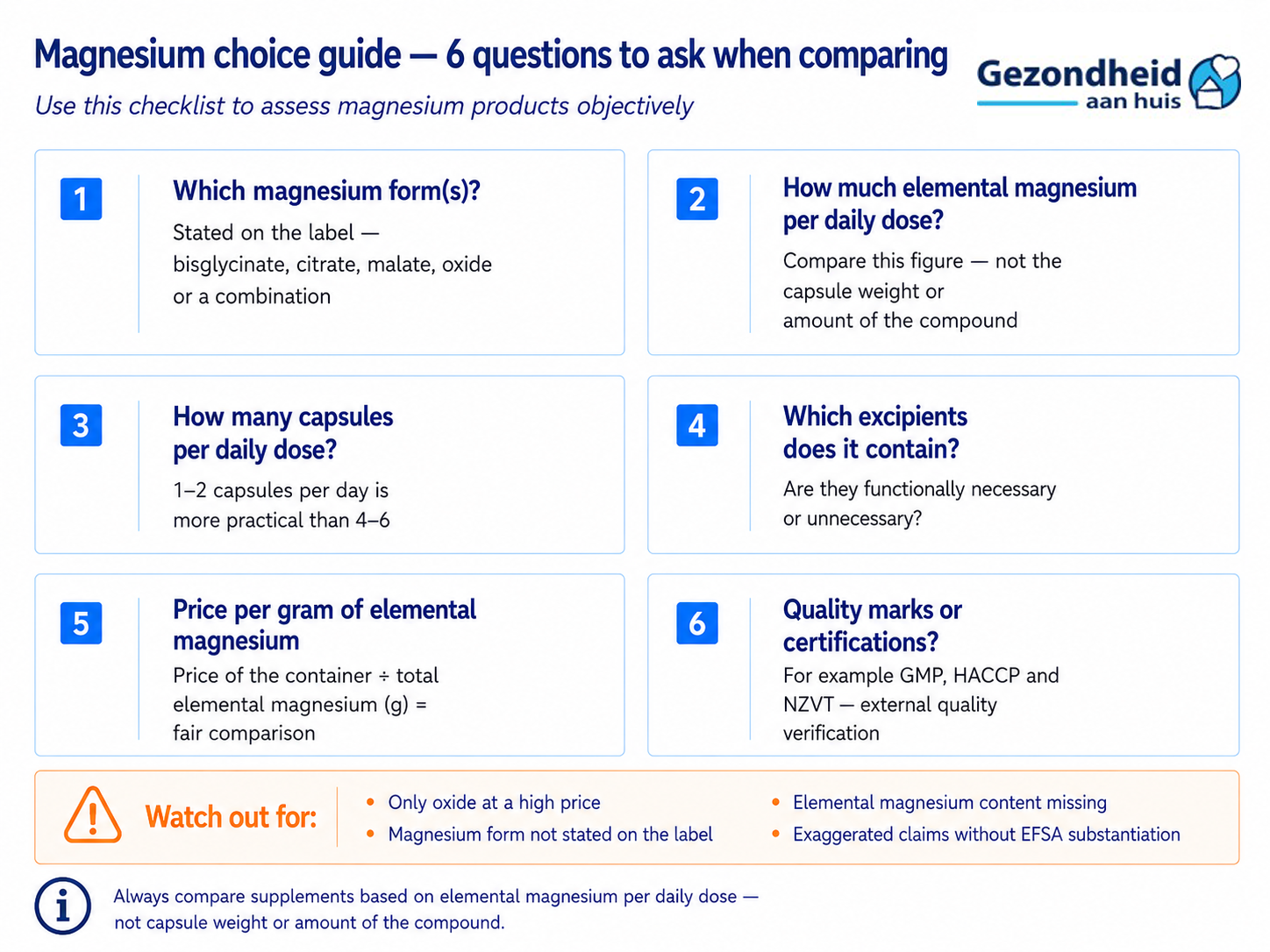
Checklist — 6 questions to ask when comparing products
- Which magnesium form or forms does the product contain? This should be clearly stated on the label.
- How much elemental magnesium does the daily dose provide? Compare this figure, not the capsule weight.
- How many capsules make up the daily dose? One capsule per day is more convenient than four.
- Which excipients does the product contain? Are they functional or unnecessary?
- What is the price per gram of elemental magnesium? Calculate this figure for a fair comparison.
- Which quality marks or certifications are stated? For example, GMP certification.
For a detailed overview of the individual forms, read “Magnesium forms compared”
Frequently asked questions
How can I compare two magnesium products fairly?
Always compare the amount of elemental magnesium per daily dose. Do not compare products based on capsule weight or the total amount of the magnesium compound.
Then calculate the price per gram of elemental magnesium to obtain a fair cost comparison.
Is an expensive magnesium supplement always better?
Not automatically. A higher price may indicate the use of more expensive raw material forms, better certification or fewer excipients.
Regardless of the price, always check the ingredient list and the amount of elemental magnesium.
What is the difference between magnesium for daytime and evening use?
The difference relates to the magnesium form rather than the amount.
Magnesium citrate and magnesium malate are commonly used during the day because of their profiles. Magnesium bisglycinate and magnesium taurate are more often used in the evening.
How much magnesium per day is safe?
The reference intake for magnesium is 375 mg per day.
The EFSA has established a safe upper intake level of 250 mg of elemental magnesium per day from supplements, in addition to magnesium obtained from food. Always follow the recommended dose stated on the product label.
Is a combination product better than a single magnesium form?
That depends on the specific combination and the proportions of the individual forms.
A well-formulated combination product offers a broader composition. A single-form product gives you greater control over the specific magnesium form you use.
Always check which forms are included and how much of each form the product provides.
Does magnesium oil work?
Magnesium oil is a topical product, not a food supplement. It contains magnesium chloride dissolved in water and is applied to the skin.
There are no approved EFSA claims for magnesium oil. There are also no official absorption figures demonstrating that magnesium is absorbed through the skin in significant amounts.
The absence of this evidence does not automatically mean that transdermal absorption does not occur. However, it has not yet been studied sufficiently to support an authorized claim.
Does my multivitamin contain magnesium?
Multivitamins often contain between 50 and 100 mg of magnesium per daily dose, usually as magnesium oxide.
Include this amount when calculating your total daily magnesium intake from all sources: your multivitamin, any separate magnesium supplement and your diet.
For general information about the functions, use and safety of magnesium, visit our main Magnesium page
Personal advice
Are you still unsure or do you have another question? Our qualified druggists will be happy to help you by WhatsApp, telephone or email.
About this article

Available in