

Knowledge Base
How to read a food supplement label
You are reading:
Contents
On this page
The back of a supplement package contains far more useful information than the front, but it isn’t always easy to interpret. A food supplement label provides exactly the details you need to make an informed choice. In this article, we walk you through each section and explain what it means.
See more search results from us on Google
Add us as a preferred source (opens in a new tab)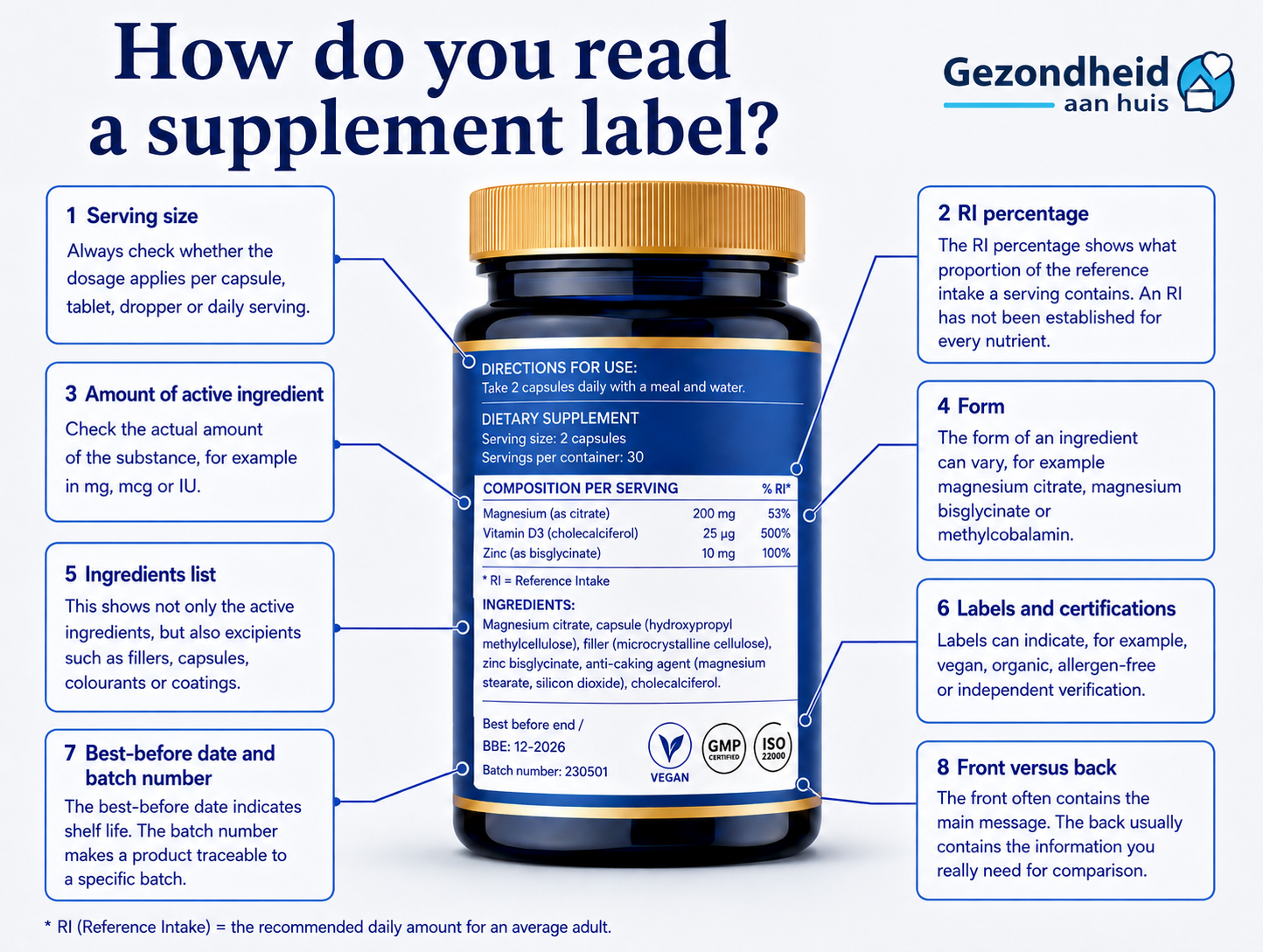
The composition table: what’s actually inside?
The most important part of any supplement label is the table showing the amount of active ingredients per serving. A serving may be one capsule, two tablets, or a scoop of powder.
Always check whether the stated amount refers to per capsule or per daily serving, the difference can be significant.
Next to the ingredient amount, you’ll often see a percentage: the NRV (Nutrient Reference Value). This is the EU‑established daily reference intake for healthy adults. An NRV of 100% means one serving provides the full reference amount. An NRV of 500% may look alarming, but for water‑soluble vitamins (such as vitamin C and the B vitamins), any excess is simply excreted through urine.
The ingredient list: more than just the active ingredient
Below or beside the composition table, you’ll find the full ingredient list. It begins with the active ingredients but also includes excipients: substances needed to give the product its structure. These may include capsule shells, fillers, binders, or anti‑caking agents.
Common excipients include magnesium stearate (an anti‑caking agent), microcrystalline cellulose (a plant‑based filler), and silicon dioxide.
Read our full explainer on excipients for what each of these does.
A frequently used capsule material is HPMC (hydroxypropyl methylcellulose), a plant‑based alternative to gelatin. HPMC capsules are suitable for vegans and vegetarians. On the label, you’ll see this listed as “plant‑based capsule,” “HPMC,” or “vegetarian capsule.”
A shorter, more straightforward ingredient list generally means fewer additives, although this alone doesn’t indicate the quality of the active ingredient.
The form of the active ingredient: which type is it?
One of the most informative, and most often overlooked parts of a supplement label is the chemical form of the active ingredient. The form determines how the nutrient is structured.
Examples include:
- Magnesium: magnesium oxide, magnesium citrate, magnesium bisglycinate
- Zinc: zinc oxide, zinc citrate, zinc bisglycinate
- Vitamin B12: cyanocobalamin, methylcobalamin
Each form has a different chemical structure, and you can identify it directly from the name on the label.
Why that chemical form affects absorption is explained in our article What does bioavailability mean?.
Certifications and quality marks
Many supplements display certification logos. Common examples include:
- GMP (Good Manufacturing Practice): an international production standard covering hygiene, processes, and quality control
- HACCP: a food‑safety system focused on preventing contamination
- ISO certification: a broader quality standard for business processes
- Vegan or vegetarian certification: confirmation that the capsule and ingredients contain no animal‑derived substances
Keep in mind: certifications relate to the production process, not to the choice of raw materials or the concentration of active ingredients.
Best‑before date and lot number
The best‑before date indicates how long the manufacturer guarantees the product’s quality and potency, provided it has been stored correctly. After this date, the supplement isn’t necessarily unsafe, but the concentration of active ingredients may decline.
The lot number (usually printed as a small code on the bottom or side of the packaging) allows the product to be traced back to a specific production batch. For reputable brands, this is standard practice and a sign of transparency.
A lot number makes it possible to determine exactly when, where, and how a product was manufactured and enables precise batch recalls if needed.
Reading labels for specific groups
- Vegans: check the capsule material: gelatin is animal‑derived. Look for “plant‑based capsule,” “HPMC,” or “pullulan.” For vitamin D3, check whether the source is lichen. For omega‑3, look for algae oil as a plant‑based source of EPA and DHA.
- People with allergies: look for “gluten‑free,” “lactose‑free,” or “soy‑free” if relevant. Excipients such as lactose, maltodextrin, and soy lecithin appear regularly in supplements.
- Athletes: look for the NZVT logo and verify the lot number in the NZVT database. For international use, Informed Sport is the only foreign certification recognized by the Dutch Doping Authority.
Summary
- Serving size: per capsule or per daily dose?
- NRV percentage: how much of the nutrient reference value does one serving provide?
- Active ingredient form: which chemical form is used?
- Ingredient list: which excipients are included?
- Certifications: which independent quality marks are listed?
- Best‑before date and lot number: are they present and traceable?
Reading a supplement label takes a bit of practice, but once you’re familiar with the components, you’ll quickly start to see meaningful differences between products.
Do you have questions about the composition of a specific product in our range? Our qualified supplement specialists are happy to help, feel free to get in touch.
See more search results from us on Google
Add us as a preferred source (opens in a new tab)