

Knowledge Base
What are excipients in food supplements?
You are reading:
Contents
On this page
When you read the ingredient list of a supplement, you’ll often come across names like microcrystalline cellulose, magnesium stearate or silicon dioxide. But what exactly do they do? This article explains what excipients are, why they’re technically necessary, and how to identify them on a supplement label.
See more search results from us on Google
Add us as a preferred source (opens in a new tab)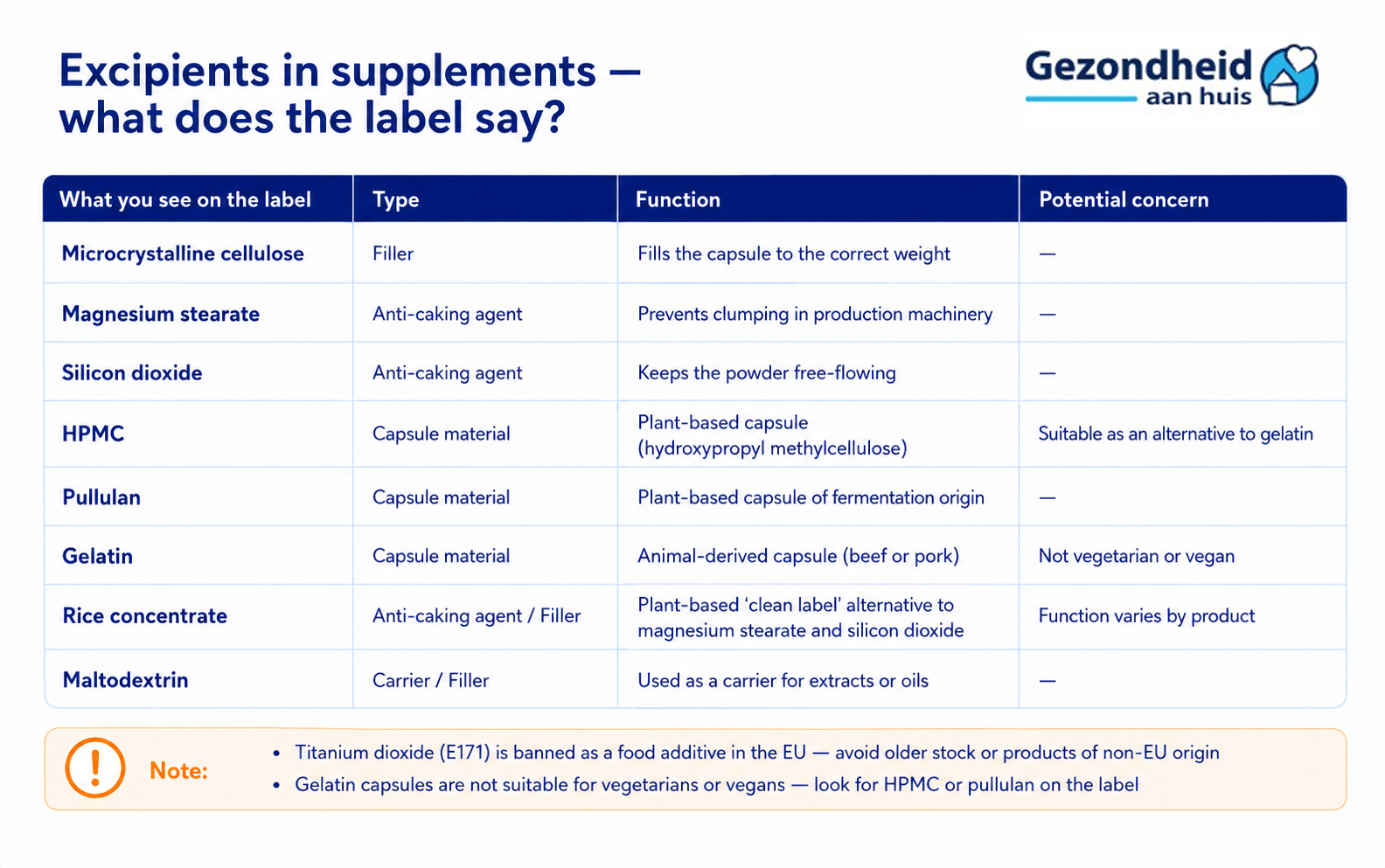
Excipients are ingredients in a supplement that don’t have an active effect on the user but serve an essential technical purpose. They’re needed to manufacture capsules or tablets, keep them stable, or make them easier to swallow.
Without excipients, capsules wouldn’t hold their shape, powders would clump inside production equipment, and tablets could fall apart before you ever use them. In most cases, excipients are therefore technically indispensable. The amount and type of excipients vary widely depending on the product and the production method. Modern manufacturing techniques can reduce the need for excipients, but the final choice always lies with the manufacturer.
Capsule material: plant‑based or animal‑based?
The capsule shell is the most visible excipient. Gelatin capsules are made from animal collagen, typically sourced from cattle or pigs.
For Muslims and Jews, gelatin from pigs is not permitted under Islamic (halal) or Jewish (kosher) dietary laws. Gelatin from cattle may be allowed under specific conditions and requires appropriate certification. If you want certainty, choose a plant‑based capsule (HPMC or pullulan). In that case, the origin of gelatin is irrelevant.
Plant‑based capsules are made from HPMC (hydroxypropyl methylcellulose, derived from cellulose) or pullulan (produced through fungal fermentation).
On the label, capsule material is usually listed under the ingredients, for example as “capsule (HPMC)” or “capsule (gelatin).” Products with vegan certification always use plant‑based capsules.
Fillers: why isn’t the capsule simply filled with active ingredients?
The amount of active ingredient per capsule is often too small to fill the capsule completely. A 500 mg capsule containing 10 mg of zinc still has 490 mg of empty space. This is filled with a filler such as microcrystalline cellulose. Without a filler, the capsule would be mostly empty and the active ingredient would be released immediately upon opening.
Microcrystalline cellulose is the most commonly used filler and is derived from plant cellulose. The body doesn’t metabolize it; it passes through unchanged.
Anti‑caking agents: essential in production
Powders used in supplements tend to clump, especially when exposed to moisture or heat. Anti‑caking agents ensure that powders flow smoothly during production and prevent machinery from clogging.
Magnesium stearate is the most widely used anti‑caking agent and has a long, established history in both the supplement and pharmaceutical industries.
Although concerns occasionally circulate about magnesium stearate, there is no scientific evidence that the amounts used in supplements are unsafe. These quantities are far below the levels at which effects have been observed in studies.
Silicon dioxide (also known as E551) serves a similar purpose.
Manufacturers who prefer a cleaner ingredient list or intentionally choose a clean‑label formulation sometimes use rice concentrate as a plant‑based alternative.
Read more about clean‑label formulations in our article Clean label supplements: what does it mean?
Maltodextrin: carrier for extracts and oils
Maltodextrin is a carbohydrate compound used as a carrier — not as a filler in regular capsules. You’ll mainly find it in products based on plant extracts or oils, where the active compound is bound to maltodextrin to create a stable powder. On labels, maltodextrin appears most often in extract‑based or powdered formulations.
Excipients in liquid and homeopathic products
Not all supplements come in capsule or tablet form. Liquid herbal products, homeopathic remedies and drops contain different types of excipients:
- Ethanol (alcohol) used as a solvent and preservative in liquid herbal extracts and tinctures. It dissolves plant compounds effectively and ensures long shelf life. On labels, listed as “ethanol,” “alcohol,” or a percentage such as “45% alcohol.” Examples include liquid herbal products from A.Vogel.
- Glycerin a sweet, viscous liquid used as a solvent, sweetener and preservative in alcohol‑free liquid supplements. It’s a suitable alternative for people who avoid alcohol, such as children, pregnant women or individuals with religious restrictions. Listed as “glycerin” or “glycerol.” Examples include liquid supplements from Nature’s Answer.
- Sucrose (sugar) used as a carrier and sweetener in homeopathic remedies. Homeopathic granules consist almost entirely of sucrose. Listed as “sucrose.” Relevant for people with diabetes or those following a low‑sugar diet.
- Water (aqua) the base for many liquid supplements, drops and syrups.
How to recognize excipients on the label
Active ingredients and excipients appear together in the ingredient list, arranged in descending order by weight. Excipients usually appear toward the bottom because they’re present in smaller amounts. These clues help you identify them:
- Names such as cellulose, stearate, silicon, maltodextrin or gelatin almost always refer to excipients.
- Capsule material may be listed separately as “shell” or “capsule (HPMC).”
- A shorter ingredient list doesn’t automatically mean higher active‑ingredient quality, but it does indicate a simpler formulation.
- Clean‑label products contain a selected set of excipients without synthetic additives.
Every supplement contains excipients. What matters is the manufacturer’s choices. Transparent manufacturers list all excipients clearly and use ingredients with a defined technical purpose.
If you use multiple supplements at the same time
Excipients are generally safe in the amounts used in individual supplements. However, people who take several supplements simultaneously may ingest higher combined amounts of the same excipients.
At Gezondheid aan huis, we therefore recommend choosing products with the cleanest possible formulations and short, easy‑to‑understand ingredient lists.
We’re happy to help you choose the right product. Contact us by phone, WhatsApp or email. You’ll find our contact details at the bottom of this page.
Sources
- EFSA ANS Panel (2018). Scientific Opinion on the re‑evaluation of sodium, potassium and calcium salts of fatty acids (E 470a) and magnesium salts of fatty acids (E 470b) as food additives. EFSA Journal 2018;16(3):5180.
- Sherrat M. et al. (2007). Safety assessment of hydroxypropyl methylcellulose as a food ingredient. Food and Chemical Toxicology, 45(12), 2338–2344.
See more search results from us on Google
Add us as a preferred source (opens in a new tab)