

Knowledge Base
What does bioavailability mean?
You are reading:
Contents
On this page
A supplement label tells you how many milligrams or micrograms of a nutrient each capsule contains. But that number doesn’t automatically reflect how much your body actually absorbs. Between intake and effect lies a crucial step: bioavailability. This explains why two supplements with the same name and the same stated amount can still differ substantially — and why the chemical form on the label truly matters.
See more search results from us on Google
Add us as a preferred source (opens in a new tab)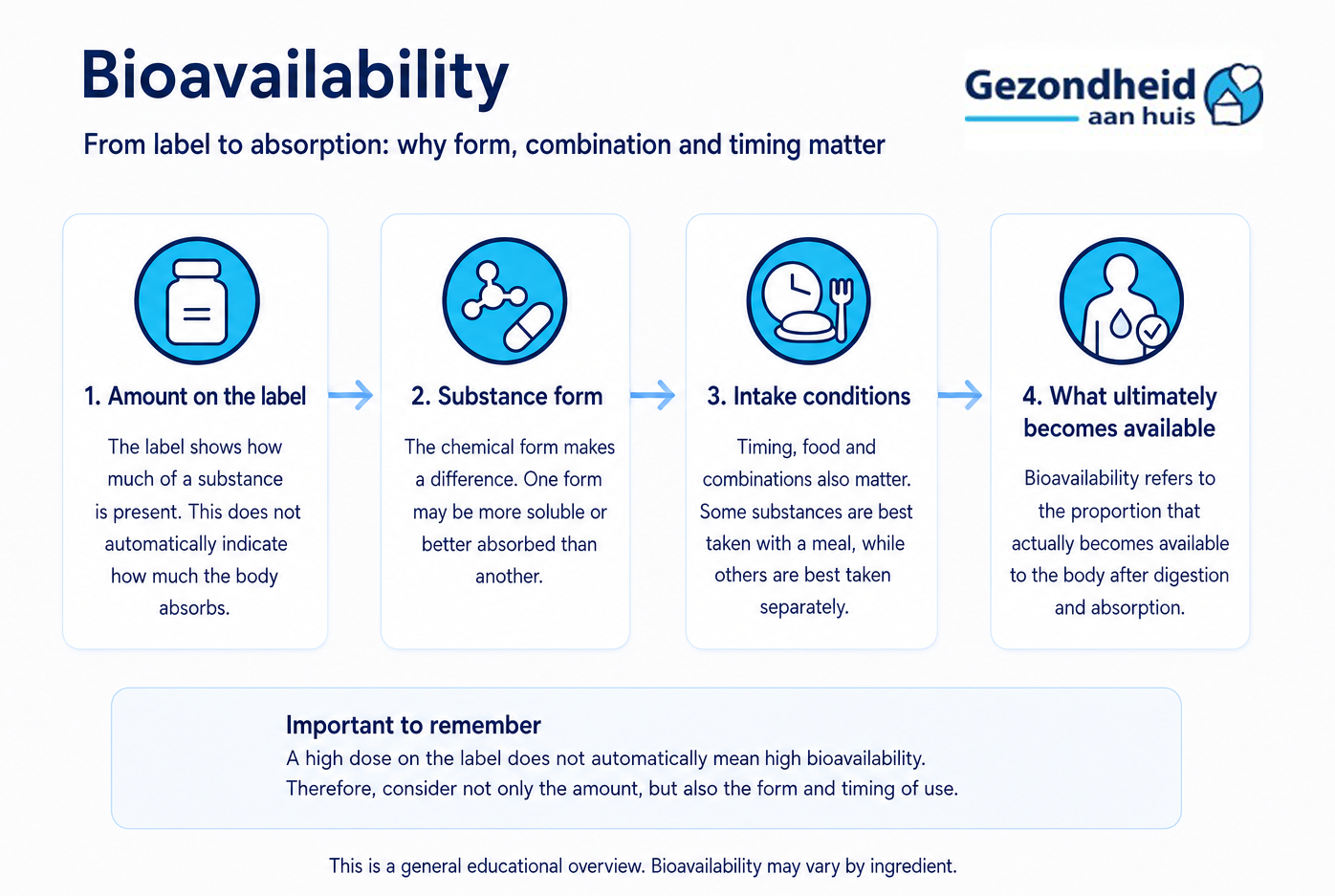
What is bioavailability?
Bioavailability is the degree to which a substance is absorbed and becomes available at the site where the body needs it. A nutrient that passes through the digestive tract without being absorbed never reaches the bloodstream — and therefore has no physiological effect, regardless of how many milligrams appear on the label.
Several factors influence bioavailability: the chemical form of the nutrient, substances that enhance or inhibit absorption, timing of intake, and individual digestion. Of these, the chemical form is the most direct — and the only one you can read from the label.
Want to understand what the chemical name on the label tells you? Read our article How do you read a supplement label?.
Organically versus inorganically bound minerals
For minerals such as magnesium, zinc, iron and calcium, the way the mineral is bound determines how well it dissolves and how efficiently it’s absorbed.
- Inorganic compounds — the mineral is bound to a simple salt such as oxide or sulfate. These are inexpensive to produce but often dissolve poorly in stomach acid.
- Organically bound compounds — the mineral is bound to an organic molecule such as citrate, glycinate, malate or bisglycinate. These forms generally dissolve better and are handled differently in the digestive tract.
Other organically bound forms you may encounter include zinc gluconate (zinc bound to gluconic acid, often used in lozenges for its mild taste) and chromium picolinate (the most widely used supplemental form of chromium).
The full ingredient name on the label tells you which form is used. For example, magnesium oxide contains more elemental magnesium per gram than magnesium citrate — allowing a higher number on the label with less powder. But the solubility and behaviour of these forms differ, which partly explains the price differences between products.
Active and inactive vitamin forms
A similar principle applies to vitamins. Some forms are immediately usable by the body, while others require conversion.
A well‑known example is vitamin B12:
- Cyanocobalamin — a synthetic base form that must be converted.
- Methylcobalamin and adenosylcobalamin — active forms that bypass this conversion step.
The same applies to folate:
- Folic acid — the synthetic form.
- Methylfolate (5‑MTHF) — the active form that requires no conversion.
Naming conventions differ by country: folic acid is known as vitamin B11 in the Netherlands and vitamin B9 in many other countries. The active form 5‑MTHF is identical regardless of naming.
For vitamin D, both D3 (cholecalciferol) and D2 (ergocalciferol) are used, but they follow different metabolic pathways.
Chelates and liposomal forms
Beyond organic binding, two technologies increasingly appear on supplement labels: chelation and liposomal encapsulation.
Chelation
A chelated mineral is bound to an amino acid so it can be absorbed via amino acid pathways in the gut. Magnesium bisglycinate is a well‑known example: magnesium bound to two glycine molecules. On the label, you’ll recognise this by the suffix “‑glycinate” or the term “chelate”.
Liposomal encapsulation
Liposomal encapsulation encloses an active substance in a fat‑based vesicle (a liposome) that resembles a cell membrane. This technology is used particularly for vitamin C and glutathione. On labels, this appears as “liposomal”.
What does this mean when choosing a supplement?
A few practical rules of thumb:
Look beyond the amount
Two products listing “400 mg magnesium” may contain entirely different compounds — and therefore behave differently in the body.
Read the full ingredient name
The chemical form tells you more than the number alone.
Compare forms, not just prices
A higher‑priced product using an organically bound mineral or an active vitamin form may provide a different effective amount than a cheaper alternative.
Bioavailability by life stage
Absorption changes throughout life.
- Older adults (60+) — stomach acid production decreases, reducing absorption of vitamin B12, calcium, magnesium and non‑heme iron. Calcium citrate dissolves better than calcium carbonate under low‑acid conditions. Methylcobalamin lozenges bypass the need for stomach acid.
- Young children — absorption of fat‑soluble vitamins (A, D, E, K) depends on dietary fat. This is why oil‑based vitamin D drops are preferable.
Bioavailability is not a marketing term — it’s a property of the nutrient itself, visible in the name on the label.
Not sure which form suits you? Our supplement specialists can help you compare products based on composition and your personal needs.
See more search results from us on Google
Add us as a preferred source (opens in a new tab)