

Knowledge Base
Food supplements: on an empty stomach or with a meal?
You are reading:
Contents
On this page
If a food supplement label says "take with water," when exactly is that? At breakfast, in between meals, or before bed? With a meal or on an empty stomach? The answer differs per type of supplement, and the choice can affect how well your body processes the substance. This article gives a practical overview per category, so you can plan your routine more consciously.
See more search results from us on Google
Add us as a preferred source (opens in a new tab)Fat-soluble vitamins: take them with fat
Vitamins A, D, E and K are fat-soluble. This means they need fat present in the gut for proper absorption. A meal with a fat component, even a small one like a splash of olive oil or a handful of nuts, helps the gut absorb these vitamins.
Omega-3 (EPA and DHA) is also fat-soluble. Take it with a meal containing fat for optimal absorption. On an empty stomach, absorption decreases, especially if you have the ethyl ester form.
If you take Vitamin D, K2, or a multivitamin with fat-soluble components on a completely empty stomach, there's a greater chance that part of the substance won't be absorbed by the body. A light meal or a snack with fat is already enough.
Water-soluble vitamins: flexible in timing
Vitamin C and the B vitamins are water-soluble. They don't need fat for absorption and can in principle be taken at any time, whether with a meal or in between. The surplus leaves the body through urine, so accumulation plays less of a role.
However, a high dose of Vitamin C on a completely empty stomach can cause stomach discomfort in some people. If you take a higher dose, taking it with a light meal is more comfortable here too. Vitamin B12 is generally well tolerated at any time of day.
Minerals: depends on the form and combination
With minerals, besides timing, the combination with other substances also plays a role. A few guidelines per mineral:
Magnesium can be taken at any time. Many people take Magnesium in the evening, because it has a relaxing effect on the muscles. On an empty stomach, Magnesium can cause mild stomach discomfort in sensitive stomachs. Taking it with a meal or a small snack is then more comfortable.
See our full guide on supplement timing for more on when to take what.
Iron is best absorbed on an empty stomach or with Vitamin C. Avoid taking it with dairy, coffee, tea, or calcium-rich meals, as these can inhibit absorption.
Calcium is best taken with a meal, in smaller portions spread throughout the day. Not at the same time as Iron or Magnesium in high doses.
Zinc is best not taken on a completely empty stomach. This can cause nausea in some people. A light meal is enough.
Herbs and plant extracts: check the packaging
For herbal preparations and plant extracts, there is no universal rule. Some extracts are better absorbed with food, others on an empty stomach.
Ashwagandha, an adaptogen, is usually taken with a meal.
Probiotics are most often recommended shortly before or during a meal, so they can pass through the stomach as quickly as possible.
The instructions for use on the packaging give the most specific recommendation for herbal products. The manufacturer has tailored the intake instructions to the composition of the product.
Absorption via the oral mucosa
Certain supplements, such as sublingual Vitamin B12, are absorbed not through the stomach but through the oral mucosa. With this method of administration, the substance already enters the bloodstream in the mouth, before the stomach and intestines come into play. The timing of intake relative to a meal then plays hardly any role.
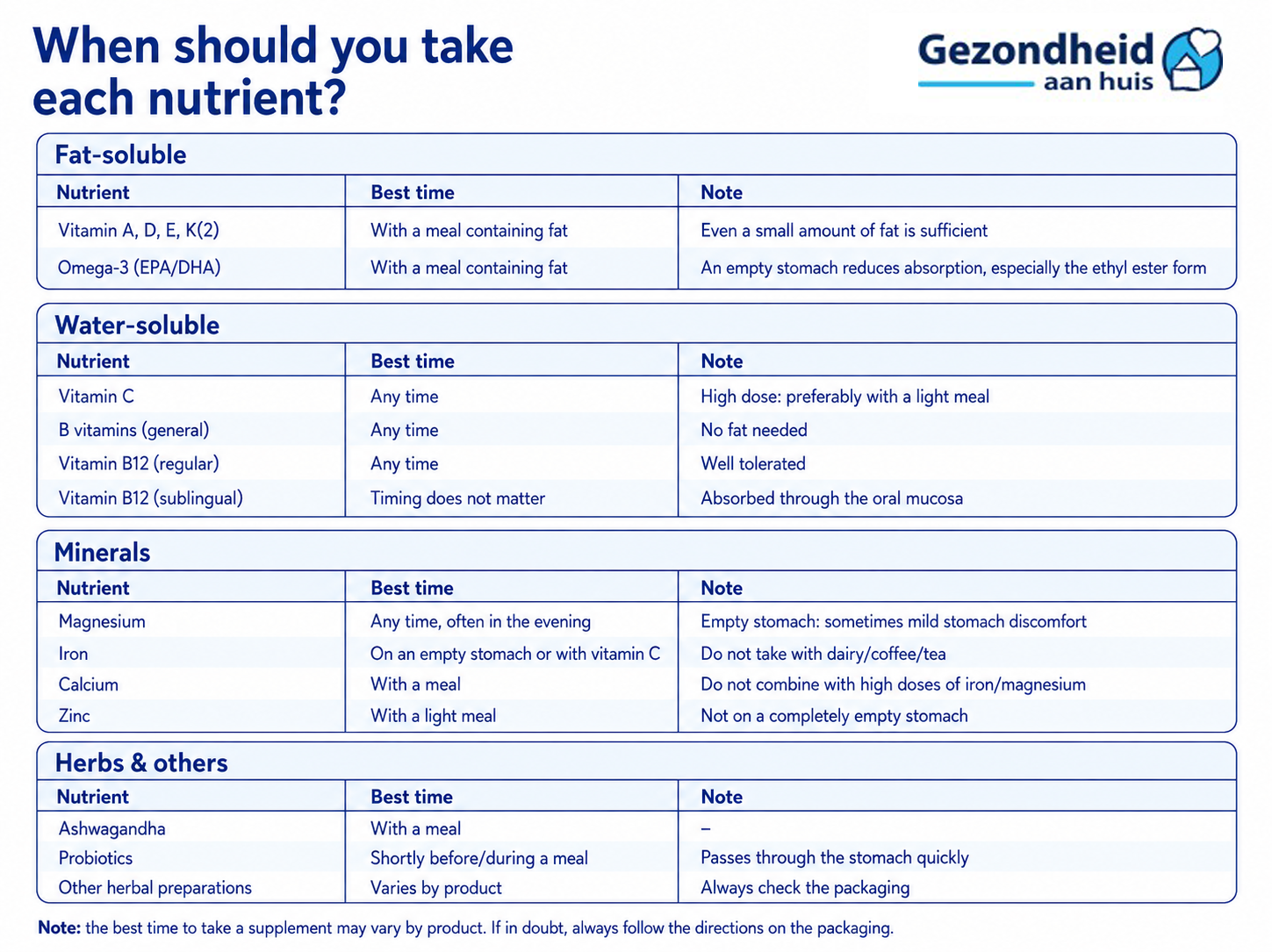
Quick overview: when do you take what?
Timing the intake of supplements is not an exact science. A conscious choice makes your routine a lot more efficient.
Do you have questions about taking a specific product from our range? Our pharmacists and orthomolecular therapists are happy to help. Feel free to get in touch.
See more search results from us on Google
Add us as a preferred source (opens in a new tab)