

Knowledge Base
Timing of sports supplements
You are reading:
Contents
On this page
In the world of sports supplements, a great deal of attention is given to timing — the exact moment of intake before, during or after a workout. For some supplements, timing genuinely matters. For others, taking them consistently every day is far more important than the precise moment.
Creatine: consistency matters more than timing
Creatine behaves differently from most other supplements. Its effect is based on saturation: muscles gradually build up a steady level, much like certain blood values. This is a long-term process created through continuous intake, not something achieved with a single dose. As a result, the exact time of day matters less than taking it reliably every day.
Research on creatine timing shows mixed results. Some studies suggest a potential benefit when taken around a workout, but the clearest finding is that a fixed daily moment you can stick to is more effective than irregular intake. A common maintenance dose is three to five grams per day.
Some people choose a loading phase — roughly twenty grams per day, divided across several servings for five to seven days — to raise creatine levels more quickly, followed by the maintenance dose. A loading phase isn’t required, however. Without one, the same level is reached, simply over a longer period of about three to four weeks.
The most practical advice is to choose a moment that fits your routine and take creatine at that same time every day, including rest days.
Protein and amino acids: around your workout
Protein and amino acids are commonly taken both before and after training. Research suggests that total daily protein intake matters more than the exact timing. A protein-rich meal or shake around your workout is a practical and widely used approach.
The same applies to BCAAs and EAAs. Their timing is less important than your overall daily intake of essential amino acids from food and supplementation combined.
Caffeine: before your workout, but not too late
Caffeine is one of the few supplements where timing clearly matters. It is most often used as a pre-workout ingredient, typically twenty to thirty minutes before training. Its half-life — the time needed for the body to break down half of the ingested amount — is roughly four to six hours. That means a significant portion remains active well into the evening if taken late in the day, which can disrupt sleep. This is especially relevant for anyone who trains in the evening.
When using pre-workout products containing caffeine, it’s important to consider your total daily intake, including coffee, tea and other sources. General dietary guidelines place the safe upper limit for healthy adults at around 400 mg per day.
Electrolytes: during and after exercise
Electrolytes are most relevant during and immediately after intense or prolonged exercise that involves substantial sweat loss. For shorter or less demanding workouts, replenishing electrolytes is less urgent.
Fat-soluble vitamins: with a meal
Vitamins A, D, E and K — and other fat-soluble nutrients — are absorbed more effectively when taken with dietary fat. A meal containing fat is therefore the most practical moment. The same applies to omega‑3 fatty acids such as EPA and DHA.
Magnesium: in the evening or with a meal
Magnesium is often recommended in the evening or with food. Some people experience stomach discomfort when taking it on an empty stomach. Magnesium bisglycinate and taurate are most common in evening formulations; magnesium malate and citrate also during the day. Curious why the chemical form matters?
Overview
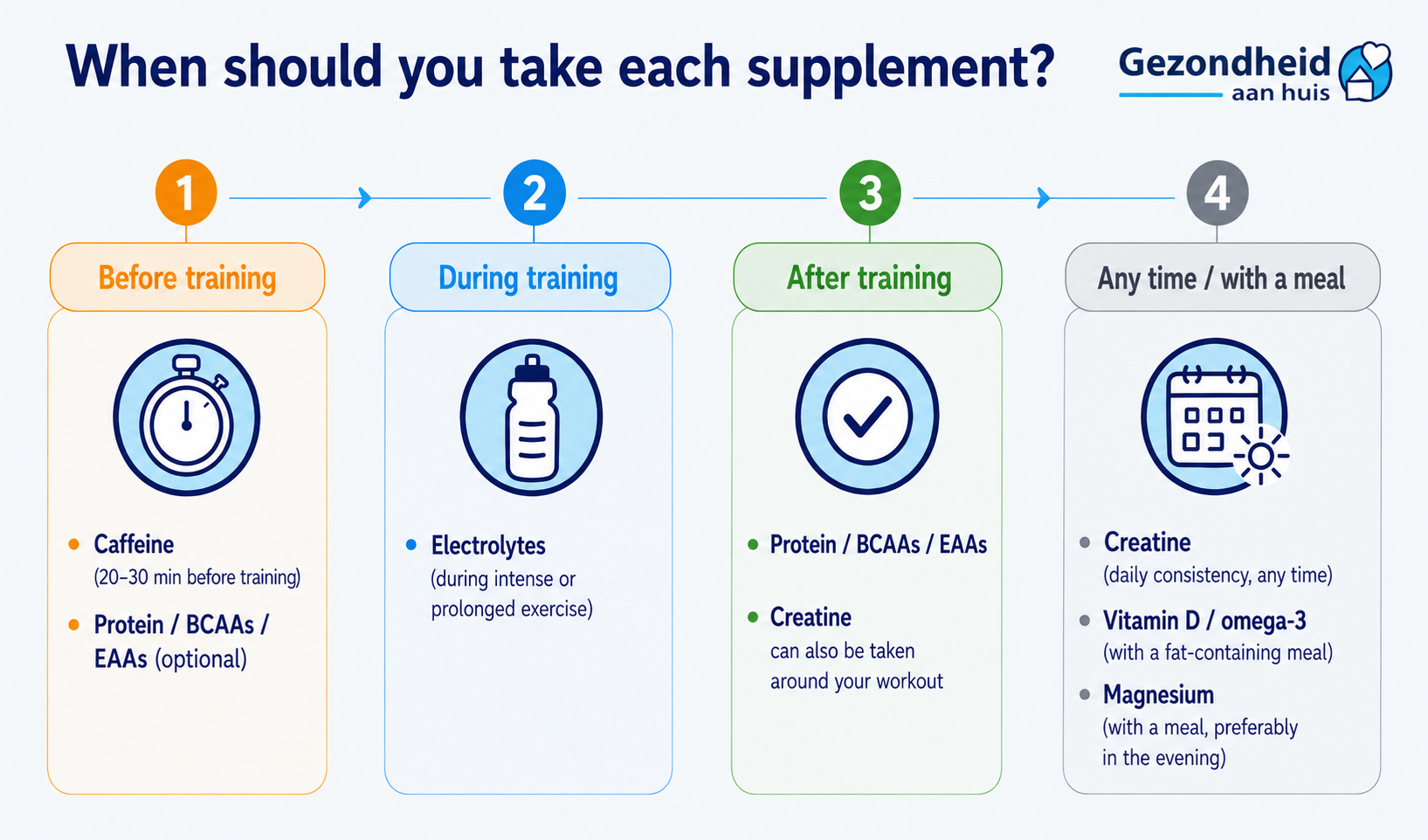
The overview below shows the most common timing for sports supplements.
Frequently asked questions
Does timing of supplements really matter
For some supplements, timing is relevant. Caffeine and electrolytes have clearly defined moments of use. For others, such as creatine, daily consistency matters more than the exact time.
Should I take creatine before or after training
Research findings are mixed. Some studies suggest a benefit around training, but the most important factor is consistent daily intake. Choose a moment that fits your routine.
When should I take pre-workout
Pre-workout products are typically taken twenty to thirty minutes before training. The ideal timing depends on the ingredients; caffeine reaches its peak within that window. Avoid taking it late in the day if the product contains caffeine.
How long before training should I take caffeine
Usually twenty to thirty minutes before training. Caffeine reaches peak blood concentration around the start of your workout. Keep the four- to six-hour half-life in mind to avoid sleep disruption.
Can I take multiple supplements at the same time
It depends on the combination. Creatine and protein are often used together. When combining supplements, pay attention to your total daily intake of each ingredient — caffeine especially, since it can appear in several products.
For more on combinations, see Combining Supplements: What Works Together and What Doesn't?
Should I also take supplements on rest days
Creatine requires daily intake to maintain muscle stores. Protein remains relevant every day through food. Caffeine and pre-workout are only relevant on training days.
Is it better to take protein before or after training
Research suggests that total daily protein intake matters more than precise timing. Both before and after training are common and effective.
If you have questions about your supplement schedule as an athlete, the qualified pharmacy assistants and orthomolecular therapist at Gezondheid aan huis are happy to help. Call +31 318 64 89 89, send a WhatsApp message to +31 683 702 040, or email info@gezondheidaanhuis.nl.
About this article

Available in