

Knowledge Base
Do my supplements work? What blood tests do and don't tell you
You are reading:
Contents
On this page
More and more people use blood tests to check whether their supplements are working. That sounds logical, but it isn’t always useful. For some nutrients, testing genuinely provides valuable information. For others, there is simply no way to determine whether a supplement is “working” through blood values. Knowing the difference helps avoid unnecessary tests — and prevents drawing the wrong conclusions.
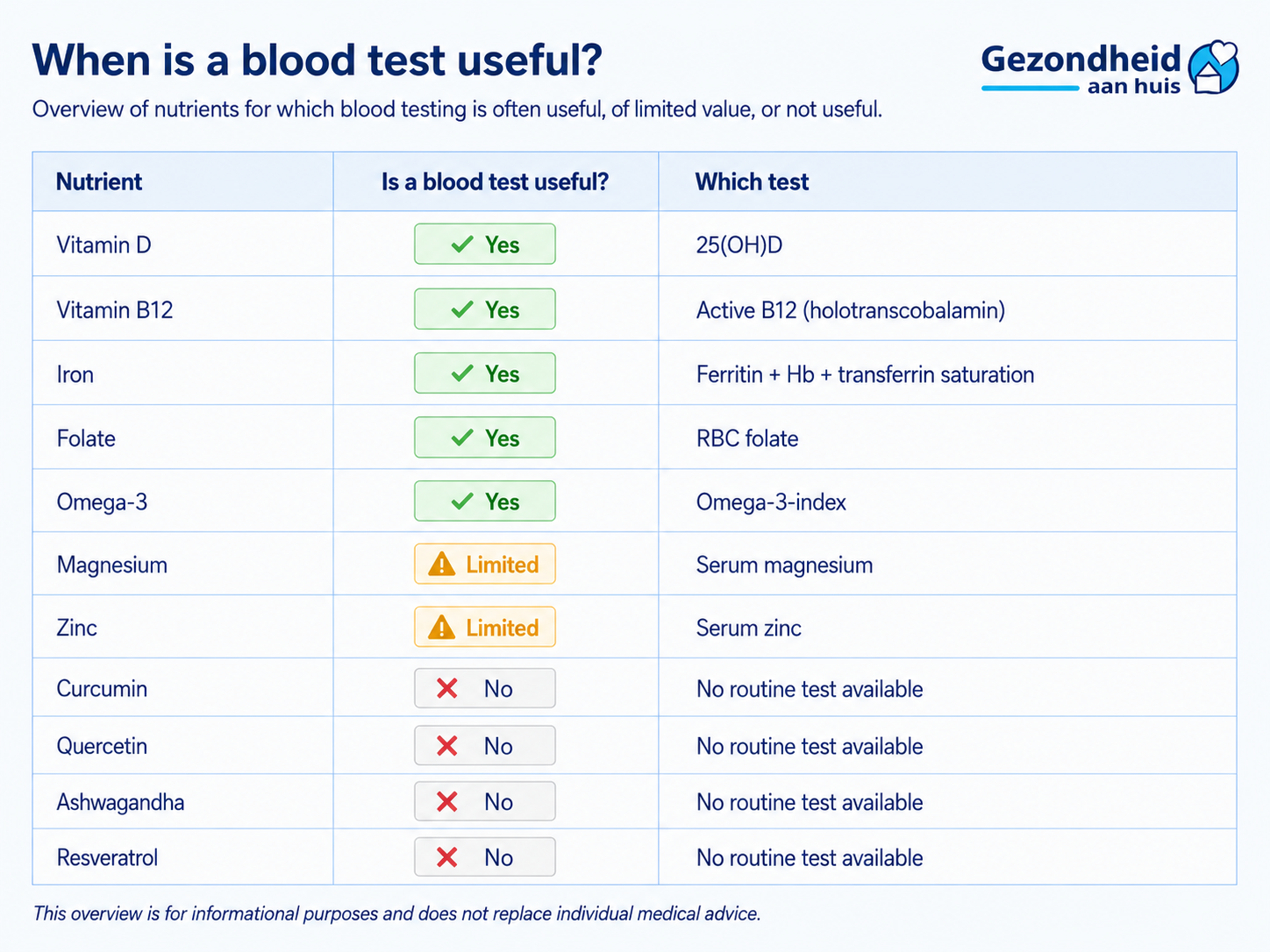
What blood can tell you about your nutritional status
For classic vitamins and minerals, blood testing works very well. These nutrients circulate in stable concentrations and have well‑researched reference ranges.
It’s important to be patient when starting or adjusting a supplement. For most nutrients discussed below, blood levels only stabilise enough to measure reliably after eight to twelve weeks.
Vitamin D
Vitamin D is the clearest example: the 25(OH)D marker is one of the most reliable blood values available. Levels below 50 nmol/L are considered insufficient, while values above 75 nmol/L are adequate for most people.
Vitamin B12
Blood testing is also useful for vitamin B12, provided the right marker is used. The standard serum B12 test gives a general indication, but because much of the vitamin is bound in an inactive form, the result doesn’t always reflect actual availability. The active B12 marker, holotranscobalamin, offers a far clearer picture.
Laboratories use different lower thresholds for this test, ranging roughly from 25 to 70 pmol/L. Always check the reference range on your own results.
Vegans, older adults and people using acid‑reducing medication or metformin benefit particularly from this more precise measurement.
Iron and ferritin
Iron status requires a combination of markers. A reliable picture only emerges when ferritin, haemoglobin and transferrin saturation are assessed together. Ferritin is a known pitfall: it rises automatically during inflammation, even when iron stores are low. Starting iron supplementation based on ferritin alone is therefore unwise.
A ferritin value below 30 µg/L is increasingly used as a threshold for iron deficiency, regardless of sex, although not all laboratories have adopted this newer cut‑off. Again, check the reference range on your own results.
Magnesium
A common question is: “My blood test says my magnesium level is fine, but I still sleep badly.” This can indeed happen, and it reflects the limitations of serum testing.
Serum magnesium is measurable, but it reveals little about actual magnesium status. Less than one percent of the body’s magnesium is found in the blood; the rest is stored in bones, muscles and organs. A normal serum value therefore doesn’t rule out a deficiency in the tissues.
A very low serum value is always meaningful, but a normal value doesn’t guarantee optimal magnesium intake for muscle function or sleep.
A more precise measurement is magnesium in red blood cells (RBC magnesium). This test is less common but gives a better indication of tissue status. You can ask your GP about it or order it through an ISO 15189‑certified laboratory.
Folate and omega‑3
Folate can be measured in serum or red blood cells, with the latter offering a more stable long‑term picture. Omega‑3 status is best assessed through the omega‑3 index, which measures EPA and DHA in red blood cell membranes. This index reliably shows whether fish oil or algae oil is having an effect — something standard serum values cannot show well.
An omega‑3 index above 8% is generally considered favourable for heart and vascular health.
What cannot be measured in blood
Common botanicals and phytonutrients cannot be assessed through blood testing. Substances such as curcumin, quercetin, resveratrol, EGCG, ashwagandha withanolides and bromelain are rapidly converted into metabolites, appear only in extremely low concentrations in the blood and act mainly locally in tissues. Because there are no standardised reference values, blood testing has no diagnostic value for these substances.
Anyone wanting to know whether a botanical is “working” should focus on noticeable changes in energy, sleep, stress resilience or recovery.
Common mistakes when interpreting blood values
A frequent misconception is that a “normal” value means everything is optimal. Reference ranges are based on population averages and say little about what is ideal for an individual. A vitamin D level of 52 nmol/L may be considered acceptable by the lab, while some healthcare professionals use higher target values.
Timing is another underestimated factor. Blood values respond to food intake, hydration, infections and even the time of day. Zinc drops during infection, while ferritin rises. A result is always a snapshot.
It is also often assumed that blood values reflect tissue status. This is especially misleading for magnesium: less than one percent of all magnesium is found in the blood. The rest is stored in bones, muscles and organs. A normal blood value therefore doesn’t rule out a deficiency in the tissues. Something similar applies to vitamin B6, where high blood values don’t always reflect actual availability in tissues.
When is testing worthwhile?
Blood testing is particularly valuable when there is a clear reason for it. People following a plant‑based or vegan diet benefit from periodic checks for vitamin B12, iron, zinc and vitamin D. Anyone using high doses of vitamin B6 long‑term should monitor blood levels to reduce the risk of neuropathy.
Medication can also influence nutrient absorption. Metformin often lowers vitamin B12 status. Acid‑reducing medication can affect magnesium and vitamin B12. The contraceptive pill influences vitamin B6 and folate. Statins reduce CoQ10 production.
For persistent symptoms such as fatigue, tingling, difficulty concentrating or hair loss, basic screening through a healthcare professional is advisable.
Buying a blood test
Ordering a blood test yourself is perfectly acceptable, provided the laboratory is ISO 15189‑certified. For classic nutrients such as vitamin D, vitamin B12 and iron, blood values can show whether absorption is going well. If levels remain low despite consistent supplementation, this may indicate an absorption issue. This does not apply to botanicals: their effects cannot be captured in blood values.
Interpreting results always depends on individual context. A test does not account for lifestyle, medical history or diet.
If you have health concerns, always contact a qualified healthcare professional.
Conclusion
A blood test is a powerful tool — but only when used for the right substances and with the right expectations. For nutrients such as vitamin D, B12, folate and iron, testing can provide valuable insights. For botanicals and adaptogens, blood testing is not the right instrument. Anyone relying mainly on plant extracts is better served by paying attention to noticeable changes in energy, sleep, stress resilience and recovery than by focusing on lab results.
Sources
NIH Office of Dietary Supplements — https://ods.od.nih.gov EFSA Dietary Reference Values — https://www.efsa.europa.eu/en/topics/topic/dietary-reference-values Voedingscentrum (Dutch Nutrition Centre) — https://www.voedingscentrum.nl WHO Micronutrient Guidelines — https://www.who.int/health-topics/micronutrients RIVM (Dutch National Institute for Public Health and the Environment) — https://www.rivm.nl
About this article

Available in