

Knowledge Base
How to recognize a high-quality supplement?
You are reading:
Contents
On this page
The range of supplements is vast, and price differences are significant. But how do you know if a product is actually of high quality and not just expensive or beautifully packaged? Quality is not found on the front of the packaging. It lies in the choices the manufacturer has made regarding raw materials, the production process, and transparency. This article provides a practical framework for evaluating supplements without needing to be a biochemist.
1. Look at the form of the active ingredient, not just the quantity
The name of an active substance on the label tells you in which chemical form that substance is present. For minerals, the distinction between inorganic forms (such as oxides and sulfates) and organically bound forms (such as citrates, glycinates, and malates) is immediately visible in that name.
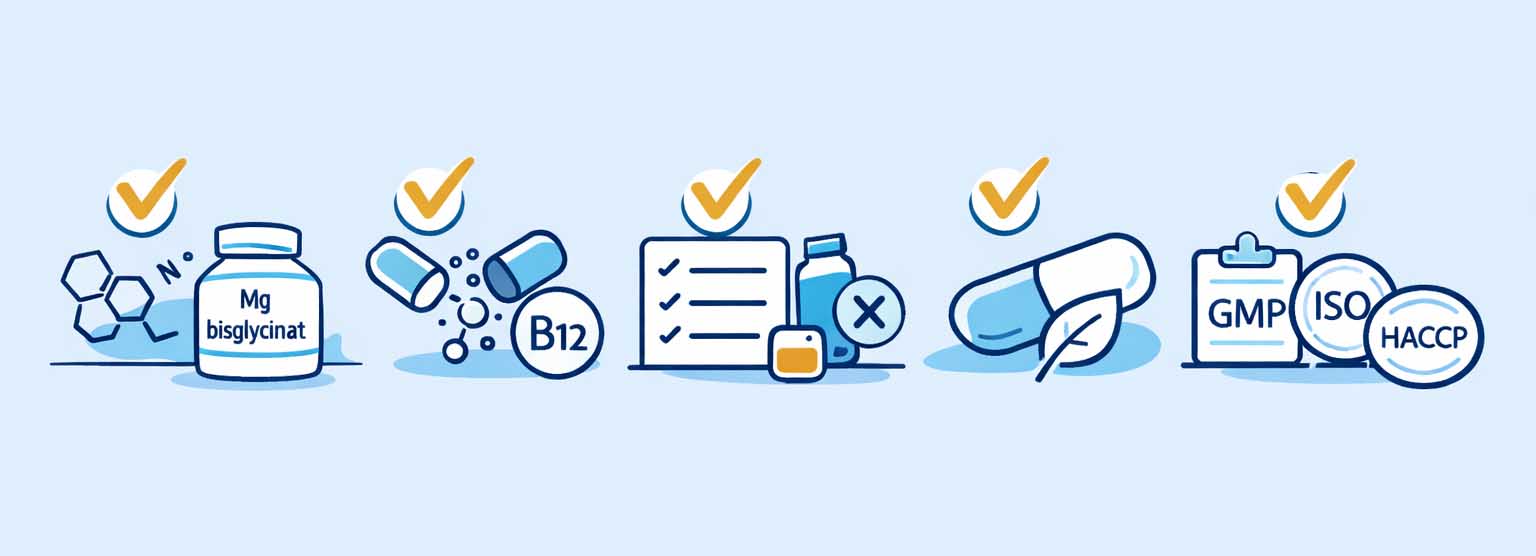
A high-quality supplement consciously chooses a specific form of the active ingredient and lists it in full on the label. So, not just 'magnesium' or 'zinc', but 'magnesium bisglycinate' or 'zinc citrate'. Products that only mention the mineral name without the binding form provide less transparency regarding their composition.
2. Active vitamin forms as a quality signal
A similar logic applies to vitamins. Some vitamins are offered in an active form that the body can use directly, while others are offered in a cheaper base form that must first be converted.
Active vitamin forms are a quality choice made by the manufacturer. They are immediately recognizable on the label, but are not necessary in all situations.
Qualitative signals on the label include: methylcobalaminor adenosylcobalamin instead of cyanocobalamin(B12), methylfolate (5-MTHF) instead of folic acid, pyridoxal-5-phosphate instead of pyridoxine (B6), and cholecalciferol (D3) in combination with menaquinone (K2).
3. The ingredient list: pay attention to the excipients
In addition to active ingredients, every supplement also contains excipients: the technical ingredients that give the product its shape. A short, recognizable ingredient list is a sign of a deliberate formulation.
Things to look out for:
- Capsule shell: vegetable cellulose (HPMC) is a high-quality alternative to gelatin of animal origin.
- Fillers: microcrystalline cellulose of plant origin is common and neutral. Talc and synthetic fillers are more common in cheaper products.
- Anti-caking agents: magnesium stearate is widely used and not harmful, but some manufacturers deliberately choose rice concentrate or avoid it entirely.
- Colors and flavors: high-quality products do not contain unnecessary additives, especially not in capsules that are not tasted anyway.
- Quality marks: production standard and independent control
Quality marks indicate the production process, not the choice of raw materials. Nevertheless, they are a relevant quality signal because they demonstrate that an independent party has checked the production process.
-
GMP (Good Manufacturing Practice): internationally recognized production standard for hygiene, process management, and quality control.
-
ISO certification: broader quality standard for business processes and internal control.
-
HACCP: food safety system that systematically manages risks of contamination.
-
**Vegan label (V-label or similar):**confirms that both capsules and ingredients are free from animal substances.
-
Independent laboratory tests: a growing number of brands publish independent analysis reports (COAs — Certificate of Analysis) for their products. This is the strongest signal of transparency a manufacturer can provide.
5. Transparency as a quality indicator
A manufacturer who chooses quality has nothing to hide. Transparency manifests itself in several ways:
- Full listing of raw material forms on the label, and thus not just the generic name.
- No exaggerated claims on the packaging. Serious brands communicate factually.
- A lot number and best-before date are standard and traceable.
- Clear indication of the country of origin of the raw materials.
- Availability of product information, analysis reports, or certifications on the website.
Quality is visible to those who know where to look. The points in this article can all be found on the label or in the product information. No laboratory is required for this.
Do you have questions about a specific product in our range? Our pharmacists and orthomolecular therapists are happy to help you.
About this article

Available in